


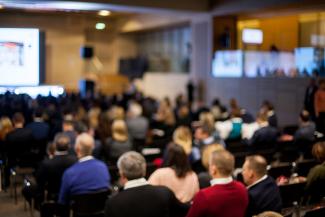
In April of this year, the forum “THE FUTURE BEGINS IN DIALOGUE. Technologies. Digitalization. Automation” was held at the RTU Rezekne Academy, bringing together entrepreneurs, scientists and technology experts. The event programme focused on the use of technologies, the development of innovations and digitalisation opportunities in business, helping companies increase production efficiency.
The Forum in Rezekne was organised as a new regional forum for business, technology and research cooperation. The event was organised by the Regional Office of the Investment and Development Agency of Latvia (LIAA) in Rezekne, RTU Rezekne Academy, Rezekne Special Economic Zone (SEZ) Authority and the Latgale Branch of the Latvian Chamber of Commerce and Industry (LTRK) with the support of the Innovative Entrepreneurship Development Programme for Small and Medium-sized Enterprises (SMEs) co-financed by the European Regional Development Fund.
Why is process modernisation important?
Technological development, digitalisation and automation are today essential prerequisites for the competitiveness of companies and countries. They help speed up processes, use resources more efficiently, reduce the risk of manual errors and make decisions based on data, experience and algorithms. The European Commission’s Digital Decade report has identified digitalisation as one of the main directions of EU development until 2030, while emphasising that Europe still needs to strengthen digital infrastructure, digital skills and the technological capacity of companies.
The practical value of automation and artificial intelligence lies in the ability to take over time-consuming and data-intensive tasks, allowing employees to focus more on analysis, customer needs, strategic decisions and the development of new solutions. A study on the economic potential of generative artificial intelligence by the international management consulting company McKinsey & Company indicates that its implementation can significantly affect productivity in many areas of work. The study estimates that generative artificial intelligence could create $2.6-4.4 trillion in additional value in the global economy annually, especially in areas such as customer service, marketing, sales, software development and research. At the same time, McKinsey & Company emphasises that productivity growth will depend not only on the implementation of technology, but also on the skills of employees, the reorganisation of work processes and the ability of companies to meaningfully use the opportunities of automation.
Meanwhile, the Organisation for Economic Co-operation and Development (OECD), which studies the processes of economic and social development and provides recommendations for national policies, indicates that in many regions the shortage of labour is hindering economic development, especially in professions related to green and digital transformation. This means that technology can help reduce the workload, restructure work and use available human resources more efficiently, but the person remains at the centre of the work process.
Exchange of experiences and panel discussions
The relevance of the forum “THE FUTURE BEGINS IN DIALOGUE. Technologies. Digitalization. Automation” was marked by the fact that Latvian entrepreneurs increasingly have to make specific decisions about the implementation of the latest technologies and the optimisation of the work of companies. Therefore, the event programme offered not only a general insight into future trends, but also practical examples of how to identify processes that can be automated, how to evaluate the usefulness of solutions and how to arrive step by step at a practically implementable solution. In the lecture “How to see opportunities in automation”, Gatis Romanovskis and Betija Muižniece from the artificial intelligence and process automation company Animas shared specific examples.
During the event, special attention was paid to the path from idea to project implementation. Pauls Irbins from RTU talked about turning an idea into a business, Armands Sīlītis from RTU Vidzeme Innovation and Lifelong Learning Center introduced RTU's cooperation projects with companies, while Andris Žuravļovs from the artificial intelligence and computer vision solutions company SIA Apply shared solutions for production automation and quality control. These examples showed that digitalisation in companies is a well-thought-out development process that affects work organisation, production efficiency and decision-making.
The second part of the forum featured two panel discussions. In the discussion “From prototype to product”, Pauls Irbins, Kaspars Škerba from Busy Tag, which develops, manufactures and exports LED-equipped productivity tools for office and remote work needs, and Lienīte Litavniece, from the Latgale Council of the Latvian Chamber of Commerce and Industry, shared their practical experience, focusing on the development of ideas and their promotion to the market. In turn, the discussion “Financing for technologies and digitalization” featured Iveta Mietule from RTU Rēzekne Academy, Skaidrīte Baltace from the regional representative office of the Latvian Academy of Sciences, Maija Meirāne from the Rēzekne SEZ Authority and Matīss Krēsliņš from the Latvian Digital Accelerator. The discussion covered available support instruments and financing opportunities for companies.
The participation of the Latvian Digital Accelerator in the forum was significant, as it helps companies assess digital readiness, prepare digital development roadmaps, receive technological consultations, test and pilot solutions before investments, as well as receive consultations on the most suitable support programmes and financing opportunities for digitalisation projects. The Latvian Digital Accelerator is designed as a one-stop shop for the development of companies’ digitalisation processes, products and services, and its activities are aimed at strengthening the competitiveness of Latvian companies with new digital solutions.
In addition to the discussions, the forum also featured a technological solutions demo zone, where participants could get acquainted with innovation and technology solutions, including artificial intelligence and research-based innovation solutions. The event participants also had the opportunity to visit the laboratories of the RTU Rēzekne Academy Engineering Centre, where the practical applications of the latest technologies were demonstrated in person. The event ended with networking, giving participants the opportunity to continue discussions on cooperation, technology implementation and funding.
Forum insights and a modern business development algorithm
The forum emphasised that the competitiveness of companies is increasingly based on the ability to effectively use digital solutions and automation in everyday processes. Automation of routine tasks reduces the risk of manual errors and speeds up repetitive processes such as data entry, document processing and sorting of customer requests. As emphasised in the forum discussions, digital tools help to plan resources more accurately, track energy consumption, optimise warehouse, accounting, personnel and administrative processes, thus improving cost control. Artificial intelligence and data analytics solutions allow for faster processing of large amounts of information, identify patterns and make fact-based decisions. The forum concluded that such solutions are becoming an essential prerequisite for sustainable business development and competitiveness. At the same time, digital solutions improve the customer experience, as they provide faster service, self-service options, personalised offers and continuous availability, for example, using chatbots or automated customer support systems. As a result of these processes, the role of employees in the company is also changing – less time is spent on mechanical work and more on tasks that require critical thinking, creativity, communication and professional judgment. The forum participants particularly emphasised the importance of developing human resource competencies in digital transformation processes. Thus, the introduction of technologies helps not only to improve processes, but also to use human resources more purposefully.
The forum held in Rēzekne confirmed that the integration of technologies and artificial intelligence tools is a pressing need in Latvia to maintain competitiveness. Close dialogue between entrepreneurs, researchers and state support institutions is an essential prerequisite for turning business ideas into high-value-added results.
Taking into account the high resonance and interest of entrepreneurs, the forum organisers announced that networking and experience exchange events of this format in Rēzekne are planned to be held regularly – twice a year.
Published: 10.06.2026


