


Breakfast in the Gauja National Park, sunset on the Baltic Sea coast, evening by the campfire and overnight stay under the starry sky at the bends of the Daugava – romantic experiences you can’t find in cities or five-star hotels. A campervan is a great choice for romantics, as it is equipped with beds and kitchen and bathroom facilities – everything you need for a trip, giving you the freedom to create your own journey tailored to your specific needs.
Summer is the best, most practical time for travelling by campervan in Latvia. During this season, travellers have full access to the coast, nature trails, swimming areas, summer events and active recreation opportunities, while the longer days allow you to plan your route more flexibly, allowing you to take your time. It’s during the summer that seaside campsites and campervan sites become much more available, as some are seasonal and welcome visitors from May to autumn. Travelling in the summer will make it easier to find a place to stay with electricity, sanitary infrastructure, water refilling and other practical services, which makes a campervan trip more convenient for the seaside or inland.
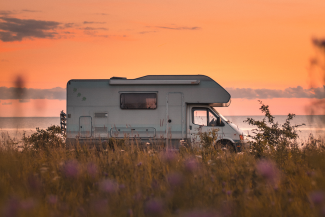
In this article, we will look at travelling by campervan in Latvia – starting with a brief insight into the history of the vehicle, continuing with useful information on why this type of travel is particularly suitable for exploring Latvia, and concluding with practical conditions that should be taken into account before setting off. As an example, we will offer a route along the Kurzeme coast to show how many beautiful stops, natural landscapes and travel options can be included even in a relatively short section of the road. It should be emphasised that there are many other exciting places in Latvia that travellers can include in their travel destinations using our portal's inspiring stories and route planner.
A look at history and the current campervan offer
The origins of the campervan go back more than 200 years. The precursors to the modern campervan were horse-drawn carriages. In 1922, the English company Eccles began the mass production of camper trailers, helping to popularise this style of travel across Europe and beyond.
As time went by, the popularity of campervans only increased, with technology improving and travel options expanding. One of the most recognisable vehicles of this type is the VW Westfalia made in Germany, which is closely associated with the travel culture of the sixties and seventies, the hippie movement, and the feeling of freedom and independence.
Today, the choice of campervans is very diverse. Larger trailers with space for everyday belongings and sports equipment, as well as transformable pop-up campers, compact sleeping vans with well-thought-out basic equipment, and spacious top-of-the-line luxury campers with a high level of comfort are available. This allows you to customise your campervan for the needs of families with children, couples, groups of friends, or those who want to travel simply, practically, and independently.
Four reasons to explore Latvia by campervan
Firstly, Latvia is ideal for campervan trips because you can get from the rocky coast of Vidzeme to Latgale – the land of blue lakes – in only a few hours. You don’t have to spend days behind the wheel, so you have more time to enjoy the trip itself. Secondly, the local rental market currently offers a wide range of modern vehicles. You can choose the one that suits your needs – from compact and dynamic minibuses to large, comfortable “houses on wheels” for the whole family. Thirdly, Latvia has an extensive and well-organised network of specialised campsites. Local recreation areas offer all the necessary infrastructure, from electrical connections to well-maintained recreation areas right by the sea. Finally, a campervan allows you to bring your bike with you, so you can enjoy the picturesque “Green Railways” or former railway routes in Northern Latvia and Southern Estonia, as well as urban cycle paths and forest and coastal trails.
Travelling by campervan and camping sites on the Kurzeme coast
The Kurzeme coast is one of the most popular tourist destinations in Latvia. It attracts travellers looking for space, silence and untouched natural landscapes. You can lose yourself in long walks along the sea, walking for kilometres along the sand and listening to the echoes of the waves and gusts of wind. After stronger winds, the coast often provides a surprising treat – pieces of amber washed up by the sea.
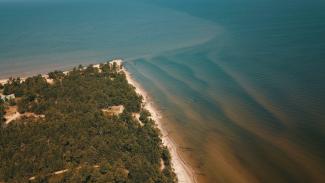
If you plan to start your trip to the Kurzeme coast from Riga, you can plan the route in one of two directions – go along the sea through Jurmala, Enguri, Roja, Kolka, Ventspils, Jurkalni and Pāvilosta, or drive through the middle of Kurzeme, stopping along the way in Kandava, Sabile, Kuldīga and Aizpute. From Kolka, the route can be continued along the sea to Ventspils, Jurkalni, Pāvilosta and Liepāja. One of the most impressive coastal landscapes of Latvia opens up at Kolkasrags – a place where the waters of the Gulf of Riga and the open Baltic Sea meet. Ventspils offers convenient city infrastructure, extensive recreational opportunities, a family-friendly environment and easily accessible sightseeing attractions by the sea, the port and the city centre. The steep Jūrkalne coast opens up an impressive coastline, where the sea, wind and sand constantly change the landscape. The Pāvilosta coast is picturesque and ever-changing, while Liepāja has a wide, pristine beach, the city of Karosta and the Ziemeļu forts.
There are several campsites on this route, located by the sea or near it, and adapted for holidaymakers with campers. Camping Miķeļbāka is located approximately 50 metres from a wide sandy beach and is great for peaceful relaxation. Ventspils Seaside Camping is located in Ventspils by the sea and offers trailer sites with electricity, water and sewage connections. In the recreation complex Imantas at the Labragas steep bank in Jūrkalne parish, the campervan sites is located approximately 30 metres from the seashore. Pāvilosta Marina is located in Pāvilosta, on the banks of the Saka River, approximately 100 metres from the sea, and offers tent sites, up to 30 campervan and trailer sites, as well as yacht moorings. In Liepāja, you can stay at the campsite BB camping, which is located in Karosta, in the Beberliņi recreation park, near the Ziemeļu pier.
Rules and regulations for travelling with a camper
When travelling with a campervan in Latvia, the general Road Traffic Regulations are binding, including speed limits, stopping and parking regulations, traffic signs and rules around securing cargo. You also need to take into account the difference between temporary parking and an overnight stay – if a canopy is installed, or chairs, a table or a grill are set up, it is no longer regarded as simply parking a vehicle, but the creation of a settlement, which is permissible only in places where it is permitted by the owner, manager of the premises or the rules of the specific establishment.
According to the regulations, a category B driving licence allows you to drive a vehicle with a gross vehicle weight of no more than 3,500 kilograms and with no more than eight passenger seats, not counting the driver’s seat. If a campervan or a car-trailer combination exceeds this limit, you should look at the specific driving licence category classifications, for example, B(96), BE or C1. Therefore, before signing a rental agreement, you need to check not only the price and equipment of the van, but also the gross weight, the permissible load, the number of seats and whether the driving licence covers the selected vehicle.
In protected natural areas, restrictions vary depending on the category and zoning of the area. In nature reserves and nature parks, general regulations prohibit leaving the roads and moving motor vehicles through forest or agricultural lands, except for specially established routes or for management, monitoring and state protection purposes. In specially protected natural areas and in the coastal dune protection zone, tents and settlements may be set up only in designated areas or with the consent of the landowner, if the regulations of the specific area allow it.
Practical tips for travelling with a camper
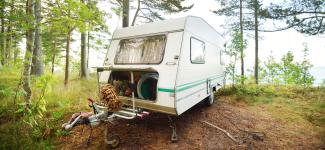
Before setting off, you should make sure that you can park your campervan on your chosen route and check where overnight stays are allowed, taking into account local government regulations, restrictions on protected nature areas, private property boundaries and procedures for using the specific location. It is also worth checking the availability of campsites, campervan sites and service points in advance, especially outside the summer season, as it won’t be possible to fill up on water or connect to electricity everywhere. Sufficient reserves of gas, drinking water and food will be useful on the road, as there may be fewer shops and service options on more remote coastal, forest and small-town routes. You should also check before the trip whether the roads are clear and safe to drive on, as some natural objects, beaches, rural tourism sites and trail starting points are located on gravel, in forests or on narrow local roads, where driving conditions can become difficult after rain. Weather conditions in Latvia tend to be quite changeable, even in summer, so it is advisable to take warmer clothing, waterproof shoes and practical outdoor equipment with you on your trip.


