


Quiet stops for culture lovers
The winds and forests of the Kurzeme coast tell legends of ancient times, and hidden treasures can be found on the more remote roads that may not even be included in typical guidebooks. These lesser-known, yet fascinating tourist attractions offer travellers an emotional and aesthetic experience – from artefacts and tales of Viking adventures to mystical underground labyrinths.
When travelling through Kurzeme, you can feel the breath of history and the powerful presence of nature at every step. In this article, we will introduce you to some special, and perhaps even lesser-known, tourist destinations in Kurzeme – places where time has stopped and everyday life turns into an adventure. We will inspire you to visit interesting tourist destinations, and you can be sure – you will develop a positive “addiction” to this wonderfully beautiful region, and sooner or later you will again succumb to the charm of Kurzeme.
Breath of antiquity in Grobiņa
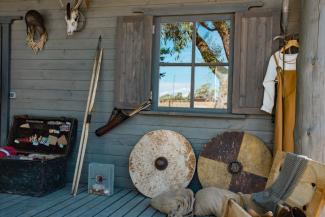
Grobina is the oldest settlement in Latvia to appear in the written record. In the Middle Ages, its castle served as the residence of Duke Jacob. The area is rich in Curonian mounds and ancient Scandinavian burial grounds, and it was here that one of the most important Viking colonies in the Baltic region was located. The Grobiņa area has been inhabited since the Stone Age, but in the 9th century, the mighty Curonian settlement of Jūrpils (Seeburg) flourished here. The Curonian Spit was so dangerous that even the Danes, foreigners and Sembians were afraid of it. The Curonian Viking Settlement in Grobiņa, created in an authentic style, is an excellent tourist gem that is well worth visiting. Here, everyone can feel like a Viking – put on a mail jacket and a helmet with horns to go on a Viking boat trip or to participate in other interesting and even theatrical events. History buffs can go on an excursion to the Grobiņa archaeological ensemble – a castle mound and ancient burial grounds, where unique evidence of the history of the Viking Age has been found. The territory of the settlement is picturesque and well-maintained, with tent sites, bonfires and picnic areas under the open sky. When spending the night here, you can watch the starry sky and imagine how the Vikings stood guard by the river.
Pāvilosta Promenade
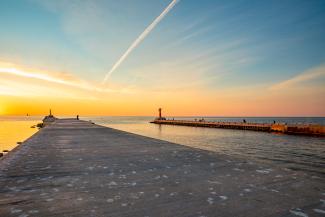
The Pāvilosta New Pier Promenade, which recently opened, invites you to enjoy the harbour’s scenery at your own pace. The 200-metre-long boardwalk of the promenade leads along the historic pier, connecting with the northern pier, which allows you to go deeper into the embrace of the Baltic Sea. While walking here, you can feel the unique smell of the sea in the air, and the view of the moored fishing boats and noble sailing yachts in the harbour waters is a treat for the eyes. Right next to it is a sandy beach, where the rolling waves rewrite the coastline every moment. The promenade is also designed as a protective wall against floods, which is why it is supported by massive concrete structures. In the evenings, you can enjoy romantic moments here and watch the sun slowly sink into the sea.
In the distance, the Užava lighthouse glows on the horizon, reminding us of sea stories and shipping lanes. More active travellers can continue along the rocky pier to the historic beacon at its end – a small lighthouse tower that has guided fishermen on the high seas over the years. The serenity of the promenade and the presence of the sea fill the heart with peace and quiet that remains in the memory long after the waves have erased the footprints on the shore.
Industrial heritage in Kuldīga
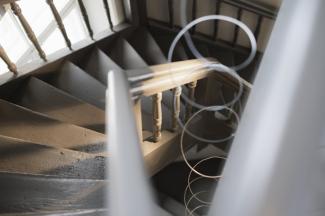
Kuldīga has been known for centuries for its romantic old town and the hub of the Venta River, but an unusual historical monument also looms over the city skyline – the Needle Tower. This tower has an interesting and unique history. It once served as a telegraph tower and a hospital, but even earlier it was home to a factory. It was in Kuldīga that the only factory in the vast Russian Empire was founded in 1854, producing various needles. Today, entering the Needle Tower, you can almost feel the aura of the ancient factory – imagine what the working rhythm of a needle factory used to be like, and how diligently and hard the factory staff had to work. When visiting the Needle Tower, everyone has the opportunity to get acquainted with the exhibition located on the four floors of the building, which tells you about the historical development of the tower, the history of needle production and use, as well as the importance and influence of the needle in medicine, music, geography and clothing production. The Needle Tower is an outstanding object of Latvian industrial heritage, endowed with a special magic and charm.
A Bridge Without Access Roads
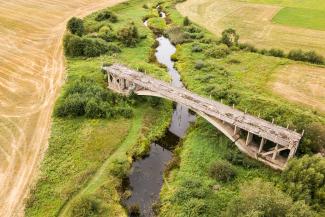
In the middle of Kurzeme, in the low meadows of the Abava River near Sātie, stands a ghostly concrete bridge that leads nowhere. It is called the Bridge to Nowhere, and the name alone is enough to stir the imagination. On one side, the bridge begins in a green meadow, leans over the Abava River with a graceful concrete arch, and on the other side it collapses into emptiness, not reaching the other bank. This 55-metre-long railway bridge is the only constructed section of the once planned Tukums-Kuldīga railway line, the construction of which was interrupted by World War II in the early 1940s. The bridge was designed and built from reinforced concrete, with lead filling the structure – it was embedded in the concrete cavities as a shock absorber, which was advanced technology at the time. Legends say that only three masters worked on the construction of the bridge, but they were never destined to see it fulfil its intended function –because the storm of war swept away all plans.
Today, the Bridge to Nowhere has become an unusual sightseeing object and cultural monument. In 2008, it was included in the European Cultural Heritage List as “Unusual Cultural Heritage”. It is a peculiar, surreal scene – a man-made engineering miracle stands in the power of nature, silence and oblivion, but by visiting it, anyone can become a part of this unusual story.
Wool processing traditions
Wool cloth has been spun and woven in Pāce since the end of the 19th century, and even today the old production equipment continues to work in the old factory. The air is filled with a distinctive aroma of warm wool and lanolin, because, unlike modern factories, the wool here is not treated with strong chemicals in the initial stage – the so-called carbonisation is not performed, which in other places burns off dirt with acids. At the Pāce Wool Factory, the wool is washed and processed gently, preserving the natural lanolin, which gives the yarn a special softness and warmth. As a result, the yarn has a unique character – when you touch it, you can feel the touch of nature and the smell of a flock of sheep. Visitors are always welcome at the Pāce factory – here you can watch the entire process from start to finish. The old mill wheel turns, spindles and bobbins wind, and white clouds of wool turn into threads that will be spun into yarn. Experienced weavers are happy to show how blankets and balls of yarn are made, and talk about the ancient crafts that have been honoured here for generations. Today, natural wool blankets, pillows and colourful yarns are made here, which can be purchased in a small factory shop right there. This place keeps Latvian craftsmanship alive, offering not only beautiful products, but also a warm feeling of connection with the heritage of our ancestors.

Longing for the horizon
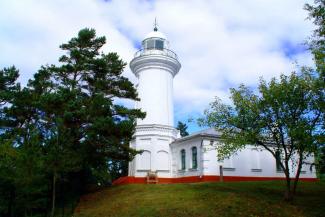
The Užava lighthouse is located in a sparsely populated area about 20 km south of Ventspils – it stands on the high Tenirokas dune right on the seashore, looking lonely and proud over the waves of the Baltic Sea. The place is almost like a fairy tale – from afar, this pine-covered dune resembles a large bread oven, which is why in the 19th century the lighthouse was called Bakofen in German, meaning “oven”. Užava was first mentioned in historical sources in 1230. Already in the 17th–18th centuries, there was information about a navigation light placed here in the form of a bonfire lit on a pile of stones, which served as a landmark for ships on their way to the port of Ventspils.
Užava Lighthouse is included in the list of state-protected cultural monuments and is considered one of the most beautiful lighthouses in Latvia – its slender, cylindrical tower with white and red stripes stands out against the background of green pine trees and the blue sea. Climbing the metal spiral staircase to the lantern gallery itself, the traveller is greeted by a breathtaking view – one of the most magnificent panoramas on the entire Kurzeme coast.
Fisherman's Farm Dieniņas
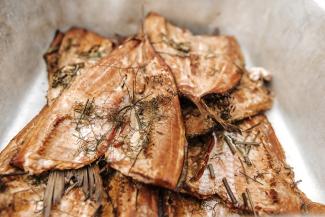
The fisherman's farm Dieniņas is located on the Engure-Kolka road in the beautiful and unique natural landscape of Bērzciems. A beautiful, approximately 160-metre-long boardwalk stretches all the way to the sea. The shallow lagoon and reeds along the coast are home to many birds. The owners of Dieniņas carefully try to preserve the traditions of fishing and fish processing, keep the authentic atmosphere of a fisherman's farm alive, and collect cultural and historical heritage. The main motivation for popularising the history and everyday life of the fishing village is a deep love for their native land and village, in order to pass on to future generations the values that have still survived. Fish products at Dieniņas are prepared according to ancient local recipes inherited from generations, using special fish processing methods specific to this place. No artificial preservatives are used in the products. The fisherman's farm offers smoked fish and other fish culinary products. Visitors can enjoy an interesting narrative linked to various activities by the sea, an improvised performance in the local dialect, and a demonstration of the fish smoking process.
Spooky Hill
On the border of Kurzeme and Zemgale, on the Strutele side near Jaunpils, there is a forested area with a scary name – Hell’s Hill. Already at the end of the 18th century, a man-made cave about 30 meters long wound through the sandstone depths of Hell’s Hill. The walls of the passage were paved in ancient times and covered with a barrel-shaped brick vault, creating a basement-like passage underground. Why was such a passage built in the mountain? There is no clear answer, but legend tells of the Devil, who supposedly lived on this mountain. Namely, the baron of a country estate had a valet – a dark and bony man, whom the baron punished by forbidding him to wash and cut his hair, beard or nails. The poor valet became increasingly terrible in appearance and went crazy, until he ran away from people and settled in a cave in the mountain. The locals were afraid of his appearance and nicknamed him the Devil. The eeriness of this mountain is given by what travellers have told, which can also be perceived with a slight smile, that sometimes their dogs cannot be persuaded to approach the cave, even with treats. Nature lovers and mystery seekers can freely visit Hell’s Hill and there are places for recreation and picnics.
Each of the sights described gives a unique range of emotions and unforgettable memories. Kurzeme invites you to knock on the door of undiscovered secrets – and everyone who does so is generously rewarded with unforgettable feelings and memories. Here you can feel like a time traveller, enjoying legends and stories about ancient times. Here you can find peace, listening to the sounds of the sea and the songs of the wind. Here you can draw energy and indulge in laziness. These are definitely feelings that inspire and invite you to return to Kurzeme again and again to discover new wonders in this unique region of Latvia.


