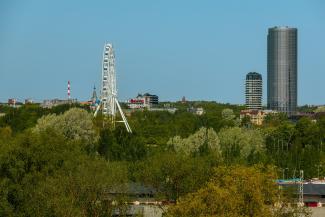


Would you like to discover Latvia from a different perspective? Coastal lighthouses, observation towers and the Riga Panorama Wheel reveal the landscape in all its splendour. In places like these, the views are truly breathtaking, offering panoramas you would never experience amid the rush of everyday life. Seeing Latvia from a bird’s-eye view is guaranteed to surprise you, allowing you to admire beautiful landscapes stretching for miles in every direction.
Latvia’s regions are home to outstanding visitor attractions that invite you to enjoy spectacular natural scenery, including historic lighthouses, observation towers and scenic hills. These locations offer a completely different perspective of Latvia, revealing the beauty of its unspoilt landscapes and sweeping panoramic views. They are perfect both for a short stop during a longer trip and as part of a full-day itinerary with family or friends, as each destination provides a unique opportunity to discover the character of the local landscape, its history and rich natural diversity. For a truly memorable experience, the modern Riga Panorama Wheel offers both excitement and spectacular views. A favourite attraction among locals and visitors alike, it allows you not only to enjoy the thrill of soaring high above the city, but also to admire Riga from well above its rooftops.
In the following sections, you’ll discover which lighthouses and observation towers offer some of the finest views in Latvia. These destinations will help you create a varied travel itinerary while exploring our beautiful and remarkable country. Let’s begin!
Coastal Lighthouses
Lighthouses have always served as essential navigational landmarks and guiding beacons for seafarers. Although modern navigation now relies on satellites and advanced technology, some lighthouses continue to function as active aids to navigation while also standing as enduring witnesses to Latvia’s maritime heritage. The oldest well-preserved lighthouse in Latvia, still operational today, is Oviši Lighthouse in the Kurzeme region. Together with the country’s other historic lighthouses, it forms part of one of Latvia’s most fascinating coastal travel routes.
Oviši Lighthouse is located in the village of Oviši, Tārgale Parish, Ventspils Municipality, where the coastline changes direction and the Oviši Shoal becomes a significant navigational hazard. Construction of the lighthouse was completed in 1814 and it has remained remarkably unchanged in terms of its architecture ever since. The tower stands 37 metres high and its light is visible from a distance of approximately 15 nautical miles. The lighthouse also houses an exhibition dedicated to the history of Latvia’s lighthouses. From the top, visitors can enjoy sweeping views of the coastal forests and the Baltic Sea, while on clear days Miķeļbāka Lighthouse and Irbe Lighthouse can also be seen in the distance.
Užava Lighthouse stands on the Teniroks Dune, approximately 20 kilometres south of Ventspils, overlooking the Baltic Sea. Construction of the original lighthouse was completed in 1879, while the present tower was built in 1925 after the first structure was destroyed during the First World War. The lighthouse tower itself is 19 metres high, but thanks to its elevated position on the dune, its light reaches 44 metres above sea level. Interestingly, the dune was once said to resemble a bread oven from a distance, which is why the lighthouse was known by its 19th-century German name, “Bakofen” (baking oven). Visitors come not only for the lighthouse itself but also for the wide sandy beach, refreshing sea breeze, surrounding pine forests and the coastal protection structures, which tell the story of the area’s long-standing battle against coastal erosion.
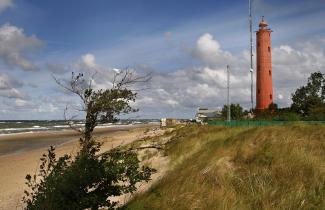
Akmeņrags Lighthouse, located in Saka Parish, South Kurzeme Municipality, is one of the most striking landmarks on the stretch of coast between Pāvilosta and Ziemupe. The current red lighthouse tower was built in 1921 after the previous structure was destroyed during the First World War. Akmeņrags has long been considered a hazardous area for navigation, as a rocky shoal extends north-westwards into the Baltic Sea, making the lighthouse an essential aid for passing vessels. Climb the spiral staircase for sweeping views of the sea, the surrounding coastal forests and the nearby shoal. The site also has an important place in Latvian history: in 1923, the steamship Saratov ran aground off Akmeņrags. Four years earlier, in 1919, the same vessel had served as the temporary refuge of the Latvian Provisional Government.
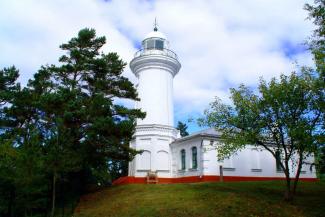
Slītere Lighthouse is located not on the coastline itself, but on the edge of the Blue Hills escarpment in Šlītere, approximately five kilometres inland from the Baltic Sea. Built in the mid-19th century, it is regarded as the second-oldest lighthouse in Latvia. What makes Slītere truly unique is that it was built at the highest elevation above sea level and is situated furthest inland in Latvia. The tower itself stands 26 metres high, while its position atop the escarpment raises the viewing point to approximately 100 metres above sea level. From the top, visitors can enjoy panoramic views of Slītere National Park, the Baltic Sea and, on clear days, distant coastal landmarks.
Mērsrags Lighthouse is located in the village of Mērsrags, Talsi Municipality, approximately one kilometre north of the village centre. It can be visited by prior arrangement through the Mērsrags Tourist Information Centre. The lighthouse began operating in 1875. Its 18.5-metre-high, free-standing riveted iron tower sets it apart from many of Kurzeme’s traditional brick and masonry lighthouses. Manufactured in Paris, it has earned the affectionate nickname “the French lady”. The surrounding landscape combines the shoreline of the Gulf of Riga, the harbour, Cape Mērsrags and nearby Lake Engure, where visitors can also enjoy excellent birdwatching opportunities.
Seven Observation Towers in Latvia Worth Visiting
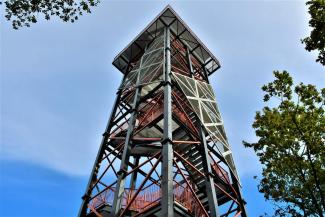
Latvia offers an impressive variety of observation towers. Some rise to more than 30 metres, providing panoramic views that stretch for miles, while others feature modest viewing platforms just a few metres high, allowing visitors to admire bog landscapes, observe local birdlife and discover the area’s characteristic plant species. In this guide, we have selected just a few observation towers that perfectly showcase the remarkable diversity of Latvia’s breath-taking landscapes.
Kuldīga Observation Tower is located in Pārventa Park, within the Venta Valley Nature Reserve. Standing 25 metres high, the tower features several viewing platforms, allowing visitors to enjoy different perspectives of Kuldīga’s historic Old Town, the Venta Valley, the Venta Rapid (Ventas rumba) and the historic brick bridge. It is an ideal place to gain a first impression of Kuldīga, as the panoramic view brings together the town’s historic centre, the winding river and the surrounding green landscape in a single breathtaking vista. The tower is illuminated after dark, open 24 hours a day and admission is free of charge.
Kamparkalns Observation Tower is located in Lībagi Parish, Talsi Municipality, at Kamparkalns, the highest point in North Kurzeme, which rises 174 metres above sea level. The tower itself stands 28 metres high, offering panoramic views of the rolling Talsi Highlands, with their forests, hills and lakes. The viewing experience is enhanced by information panels on the platform, which help visitors identify the surrounding parishes and landmarks visible in the distance. In winter, Kamparkalns becomes a popular destination for outdoor activities, thanks to its illuminated ski slopes.
Dēliņkalns Observation Tower stands atop Dēliņkalns, the highest hill in the Alūksne Highlands. The tower rises 27 metres above the summit and features a viewing platform equipped with binoculars and panoramic information boards, helping visitors identify the surrounding landscape. From here, the views stretch across Northern Vidzeme and, on clear days, extend as far as neighbouring Estonia. Dēliņkalns also has a long tradition of observation towers, making it more than just a modern viewing platform – it is a destination with a rich history of tourism in the Alūksne region.
Lielais Liepu Hill, located in Rēzekne Municipality, rises 289.3 metres above sea level, making it the highest peak in the Latgale region and the third-highest in Latvia. At its summit stands a 34-metre-high wooden observation tower, offering sweeping views of the surrounding countryside, Lake Rāzna and many of Latgale’s other lakes. From the car park, visitors can reach the tower via the 830-metre Lielais Liepu Hill Trail, which is equipped with information boards, rest areas and swings. A well-maintained recreation area is also available, featuring a paved fire pit, benches, an open-air stage and additional swings, making it suitable for both relaxation and small events. Nearby is Dzerkaļi Hill, which rises 286.3 metres above sea level and holds the distinction of being Latvia’s greatest relative elevation, rising 89.2 metres above the surrounding landscape.
Vasargelišķi Observation Tower stands 24 metres high and offers a bird’s-eye view of the spectacular Daugava Bends. On one side, visitors can admire the impressive Rozališķi Bend, while on the other they will recognise the iconic view that once appeared on Latvia’s 10-lats banknote. Here, the River Daugava is particularly picturesque, winding gracefully through forests and meadows rather than flowing in a straight line. The tower is an ideal stop when exploring the Daugava Bends region, providing the perfect opportunity to take in one of Latvia’s most recognisable river panoramas at a leisurely pace.
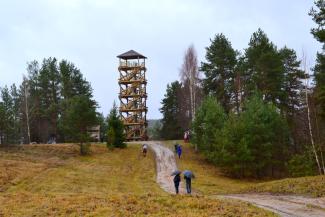
Taborkalns Observation Tower is located in Sēlpils Parish, Jēkabpils Municipality, on the summit of Taborkalns, which rises 157.8 metres above sea level. From the 28-metre-high tower, visitors can enjoy panoramic views of the rolling hills of Sēlija, the River Daugava and Lake Vīķezers. Built in 2021, the tower stands beside the “Dabors–kalns” point of the Struve Geodetic Arc, adding a fascinating scientific and UNESCO World Heritage dimension to the experience of exploring the surrounding natural landscape.
The Great Ķemeri Bog is one of the largest raised bogs on Latvia’s Baltic coast, covering an area of 5,000 hectares. Formed around 8,000 years ago, it offers visitors a unique opportunity to experience an ancient wetland landscape. The boardwalk leads through a world of mosses, bog pines, pools, dark peat lakes and the fragrant blooms of bog rosemary. Keen observers may spot the insect-eating sundew, as well as a variety of bird species, including the wood sandpiper, white wagtail and tree pipit, while the calls of cranes can often be heard in the distance. Visitors looking for a shorter walk can follow the 1.4-kilometre circular boardwalk, while those who embark on the 3.4-kilometre route are rewarded with an observation platform offering magnificent panoramic views across the bog landscape from above.
The Riga Panorama Wheel
The Riga Panorama Wheel is located within the newly redeveloped Victory Park and has quickly become a striking addition to Riga’s cityscape as well as a popular attraction on the left bank of the River Daugava. Standing 65 metres high, this impressive observation wheel features 30 enclosed cabins, with each ride lasting approximately 15 minutes. It offers visitors a unique opportunity to admire Riga as a historic, charming and atmospheric city, where elegant bridges, medieval church spires and the modern architecture of Pārdaugava come together in one spectacular panorama. The wheel is situated in Āgenskalns, just a short walk from the Old Town. The route to the attraction crosses the Stone Bridge, offering picturesque views of both banks of the Daugava and the chance to stop at the Latvian National Library, one of the most iconic examples of contemporary architecture in Riga. Following its recent redevelopment, Victory Park itself has been transformed into a spacious and attractive green oasis, ideal for leisurely walks, outdoor recreation and enjoying nature in the heart of the city.