


Riga, the capital of Latvia, is a place where art can be found not only in museums and galleries, but also in the city's streets, buildings and squares. They have a special aura, as they combine traditional and modern art forms, expressing themselves in various sculptures, paintings, stained-glass windows and even light installations. Art objects on the streets of Riga not only decorate the city, but also encourage public reflection on history, culture and modern life. Therefore, it is worth staying in Riga longer to enjoy the culture and art of the city's streets slowly and leisurely, on a leisurely walk or by bike.
The Freedom Monument
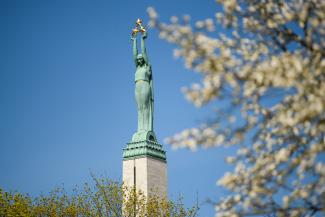
The Freedom Monument is one of the most well-known symbols of Latvia and one of the main places in Riga, attracting both locals and tourists. The monument, clad in granite and copper, in the centre of Riga symbolises the statehood of Latvia, the unity of the people, independence and freedom. The monument was built with the help of public donations in memory of those who fell in the struggle for freedom and was opened on 18 November 1935, according to the project of Kārlis Zāle “Shine like a star!”. The Freedom Monument expresses the idea of independence.
The image of Freedom – a young woman with three gilded stars in her hands, symbolising the unity of the three cultural and historical regions of Latvia. The words "For the Fatherland and Freedom" are engraved at the foot of the monument. Today, a guard of honour stands at the Freedom Monument, symbolically confirming the sovereignty of the country. The ceremony of the Changing of the Guard of Honour at the Freedom Monument is a ritual that attracts the attention of tourists. The celebration of any event important to Latvia usually takes place at the Freedom Monument, and it attracts large crowds.
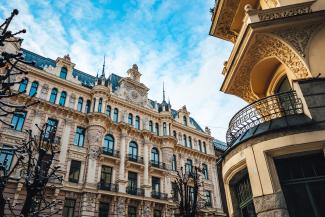
Architecture of Alberta Street and its surroundings
Alberta Street is one of the most elegant and artistic streets in Riga, known for its architecture, which is characterised by Art Nouveau elements. Eight houses have been recognised as architectural monuments of national importance. Each of the houses on Alberta Street is a unique achievement of 20th century construction, and its construction took place in a fairly short time – from 1901 to 1908. We can also find excellent examples of Art Nouveau architecture in the vicinity of Alberta Street. Each of the houses is decorated with figurative sculptures, facades are raised with balconies, covered with columns and other elements, which are covered with abstract swirls in the best traditions of Art Nouveau. The “Riga Art Nouveau Centre” has also been opened on Alberta Street, where you can get acquainted with this unique style.
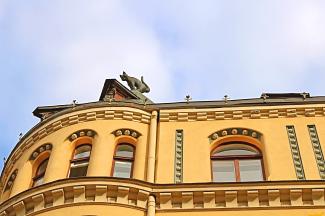
Art object “Cat House”
“Cat House”, located in the centre of Riga, is another significant art object that gives the city mystery and charm. In Līvu Square, opposite the Great Guild Hall, cats are placed on the corner towers of the building. These cats have given the name to this building – the famous “Cat House”, which once had a scandalous reputation and even caused a lawsuit. “Cat House” was built in 1909 according to the design of architect Friedrich Scheffel, who, together with Heinrich Schöll, is considered the founder of Art Nouveau in Riga. The owner of the house was a wealthy Latvian merchant who was not accepted into the Great Guild Hall. This decision deeply offended him, so he installed expressive cat figures on the roof of his house, their tails pointing towards the Great Guild building, thus clearly expressing his position towards this merchant organisation. The “Cat House” was designed in the style of a medieval fortress and complemented with Art Nouveau colours, which brought colour and romance to the city, but in this case also a little sarcasm.
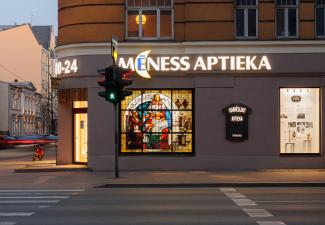
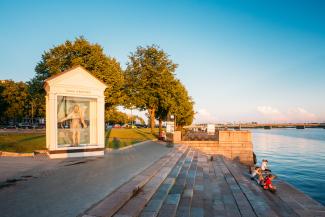
The storefront of the Moon Pharmacy “Kamēlija”
In January 2025, a stained-glass window by the notable artist Tenis Grasis was unveiled in the shop window of the “Moon Pharmacy “Kamēlija”” on Brīvības Street after restoration. The work of art was created more than 40 years ago specifically for this pharmacy. The work, titled “Dziesma”, depicts a folk girl. In 1985, it was placed in the windows of the 24-hour pharmacy opposite the “Corner House” (the building of the USSR State Security Committee), boldly demonstrating the resistance movement in the subtext. The stained-glass window was restored as part of the reconstruction of the “Moon Pharmacy “Kamēlija”. The pharmacy itself can also boast a 100-year-old history, which is now also reflected in another shop window nearby. It was highly appreciated in the Latvian Construction Association Annual Award 2024 competition, winning 2nd place in the “Restoration” nomination. At the same time, stained-glass is now one of the rare art objects decorating Riga's shop windows, honoured by highlighting the cultural values of the last century.
Sculpture “The Bremen Town Musicians”
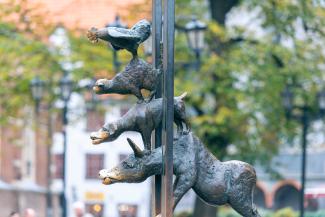
In 1990, Riga's twin city of Bremen gifted Riga with the sculpture “The Bremen Town Musicians”, based on the characters of the well-known fairy tale by the Brothers Grimm. Unlike the original sculpture, which depicts animals looking through the “window in the robbers' room” at Bremen Town Hall, the Riga version offers a new interpretation – the animals watch the world through a gap created in the “Iron Curtain” barriers built during the Cold War. Thus, the sculpture created by Krista Baumgartel is a politically charged allegory that, using the language of Aesop, expresses an attitude towards the fall of the borders of the Soviet bloc and expresses joy over the reunification of Europe.
Sculpture “Great Kristaps”
“Great Kristaps” is a legendary figure who, according to legends, has protected Riga. His veneration officially began at the beginning of the 16th century, when he was especially revered as a patron and benefactor among Latvian porters, raftsmen, loaders and burden bearers. Even today, a sculpture of Great Kristaps awaits visitors on the banks of the Daugava River. The sculpture is located near the Stone Bridge and is one of the symbols of Riga, which still retains its importance in the city’s identity.
Sculpture “Two Rainis”
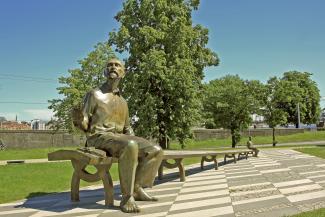
The sculpture “Two Rainis” near the National Library of Latvia depicts two images of the Latvian poet Rainis. This sculpture symbolises the diversity of Rainis’ personality and creative heritage, which has influenced not only Latvian literature, but also the entire culture. It is a symbolic link to the history of Latvian culture and at the same time emphasises the importance of the poet in the life of modern Latvia. If a Latvian had to name a significant Latvian cultural figure, it would most likely be Rainis, and there could be many reasons for this. Someone encountered him at school, someone else found strength in his works to fight for Latvia’s independence, and still someone was inspired by his written works on the path of their own creative growth. Rainis is considered a genius who changed the history of Latvia, helped Latvians understand true values, and made a significant contribution to the formation of our country. He introduced the idea of continuous movement forward, which has been inherited from generation to generation, and his works continue to serve as inspiration for this idea.
Sculpture “Counter of Riga Towers”
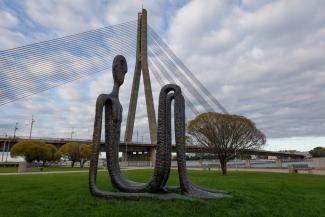
The sculpture “Riga Tower Counter” is located on Balasta Dam near the “Swedbank” building. This work of art depicts a man counting the city’s towers, indicating their diversity and architectural value. The apparent flexibility of the sculpture “Riga Tower Counter” is enriched by the expressive and nuanced bronze surface texture. The stylisation used in the compositional solution is expressed in stretched proportions and the rhythmic repetition of vertical body elements. The flexible lines of the silhouette contrast with the dominant horizontals on the banks of the Daugava River. The sculpture is a unique, romantic element in the cityscape, attracting the attention of every passerby.
Sculpture “Rīdzinieki”
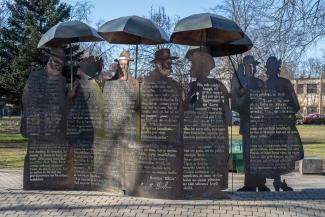
At the intersection of Pärnu, Valmiera and A.Deglava streets, passers-by are surprised by the environmental sculpture “Rīdzinieki”, dedicated to the writer Augusts Deglavas and his novel trilogy “Rīga” written more than 100 years ago. The unusual composition is made of copper sheets, pierced by perforated letters that create a magical play of light. The text covers the entire 7-metre-long and 2-metre-high surface like a gigantic page of a book. The lighting, which flows from under the umbrellas onto the texts, plays a special role. In places it alternates with the light installed in the pavement surface, in places – with the ancient lanterns that illuminate the nearby surroundings.
Sculpture “Omnibus”
The environmental sculpture “Omnibus” or “Horse Tram” is in the square on Mazā Kalna Street, where the hay market used to be. The sculpture was created in honour of the omnibus traffic in Riga, which was opened in 1852 and which eventually developed into a horse-drawn tram and in 1901 – into an electric tram. Sculptor Andris Vārpa used street railway tracks, square iron and concrete to realise the idea. The three-metre-high vertical composition consists of a reinforced concrete base, on which an omnibus wagon is raised, above which the figure of two horses and a human coachman is fixed. It is light, airy, transparent – as if drawn in the air
Art object “Giant fox”
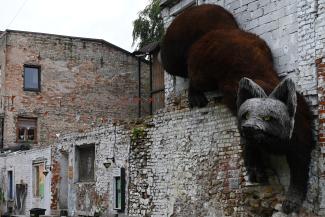
Attention! A giant fox is roaming Riga! But seriously, in the Lastādija creative quarter there is a unique art object dedicated to animal protection – a giant fox. The sculpture, created by sculptors Aleksandrs and Oleg Marinokhs in collaboration with the association “Dzīvnieku brīvība”, invites you to think that no animal deserves to live in a cage. The sculpture was installed to advocate for the protection of all animals used in fur farming and industrial animal husbandry. The sculpture is particularly attractive to both art and nature lovers, as it reflects the interaction of humans with nature.
Light Festival “Staro Riga”
As the country celebrates its independence day, the Proclamation Day of the Republic of Latvia, everyone is invited to enjoy the light festival “Staro Rīga”, which takes place annually from 15 to 18 November. This festival is one of the largest light festivals in Northern Europe. It was launched in 2008 to celebrate Latvia’s 90th birthday and has become an indispensable part of the Latvian birthday celebrations in Riga. Before you go to enjoy the street life of Riga and the pearls hidden there, choose the most convenient way to get around – on foot or by bike. Riga has an excellent infrastructure of bicycle paths, so this is a good way to get around Riga in the warm season. Also, use the city’s public transport safely, which is a convenient and safe means of transportation. To maintain a sharp mind and good physical condition, it is important to drink enough drinking water. Therefore, remember that there are free drinking water taps in Riga. The water here is delicious and refreshing.