


Caves, cliffs and rock outcrops are an important part of Latvia’s natural heritage. Under the influence of long-term water, wind and temperature fluctuations, underground passages, niches, arches and sandstone walls are common natural features. These sites attract visitors thanks to their unusual shapes, different shades of rocks, ancient engravings and stories that have survived to this day.
In Latvia, Devonian sandstone outcrops are particularly striking in the valleys of the Gauja, Salaca and Amata Rivers, in ravines and on steep forest slopes. Running water has carved cracks, hollows, overhangs and underground passages in them for thousands of years, a process that is still underway thanks to wind, precipitation and temperature fluctuations. The colour bands and sedimentary patterns visible in the exposed walls testify to ancient currents and the accumulation of sand several hundred million years ago. The appearance of each location is determined by the structure of the rocks, the relief and the influence of the surrounding environment.
Let’s take a short trip to explore the most remarkable geological natural monuments of Vidzeme – from the caves and sandstone cliffs of the ancient Gauja valley to the cliffs formed by the waves on the coast. Get ready to be impressed!
The mysterious caves of Vidzeme
The best place to discover the secrets of the Vidzeme underground world is Gauja National Park, where water has transformed the slopes of the ancient valley into niches, hollows and grottoes over thousands of years. The most notable of these is Gūtmaņala near Turaida – 18.8 metres long, 12 metres wide and up to 10 metres high, recognised as the largest in the Baltics by volume. In the yellowish-brown sandstone of the Gauja Formation, the cavity was initially washed out by the river current, and the process has since been continued by groundwater seeping through the rock. The history of the site is preserved in engravings, the oldest of which have survived since the 17th century. The names, coats of arms and dates of barons and lords were engraved for a fee by masters who welcomed wealthy travellers with ladders, stencils and tools. The story of the Rose of Turaida is also closely connected to this place, while nearby Victor Cave, according to legend, was carved by Victor Heil for his bride. Due to the fragile rock, the ancient inscriptions can only be viewed (no touching allowed), but the water still flowing from the grotto slowly continues to transform them.
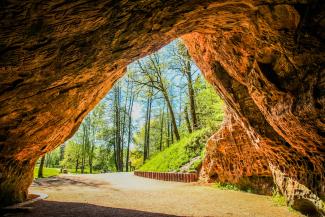
In the Vējupīte ravine of the ancient Gauja valley, high above the river, lies the hidden cave of Pēteris. It resembles a narrow, 6.3-metre-long and up to 6.4-metre-high crack in a reddish rock wall. A staircase and platform with railings lead to the entrance. The name of the cave is explained by several stories from the Swedish period. The best-known story is about the farmer Pēteris, who hid in a cave during the war and went to the Sigulda rectory to ask for bread. When his request was refused, he grabbed a freshly baked loaf and fled from his pursuers. Bats tend to reside here in winter, so it is necessary to be silent during the visit and refrain from touching the cave walls.
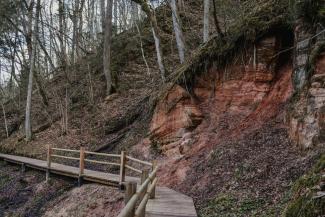
The most impressive part of the Piķene ravine is the Velnala cliffs – a 250-metre-long wall on the right bank of the Gauja that rises up to 15 metres in height. Eight metres above the river is a cave carved out by lateral erosion of the Gauja more than 10,000 years ago and an underground spring that later disappeared. The depth of the cave reaches 35 metres, and six holes can be seen in its ceiling, which are popularly known as the devil’s chimneys. The ancient pagan cult site was first mentioned in written sources in 1857, when the magazine “Das Inland” called it “Taufelshöle” or in Latvian – “Devil’s Cave”. Until 1980, a narrow path, stairs and a platform built above the Gauja led to the entrance along the edge of the ravine, but today the cave can only be viewed from the opposite bank.
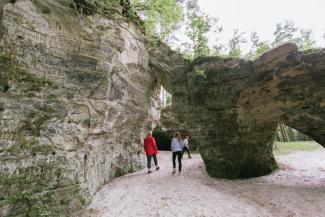
The last stop on the cave tour is the Great Ellīte in Liepā near Cēsis, also known as the Devil’s Forge. Here you can see the only naturally formed sandstone arch complex in Latvia – the total length of the cave passages reaches 23 metres, and in front of it three arches connect in an unusual arcade. An underground spring has transformed the fragile rock for thousands of years, forming passages, niches and peculiar supports. The origins of the Ellīte can be traced back to the end of the Ice Age, giving it an estimated age of 6,500–7,000 years. The cave, together with the spring, once served as a sacred place, but the first written information about it can be found on a map from 1791, where it is marked with the name “Grotte Welnuzeppel”, which in Latvian means “Devil’s Forge Grotto”.
The most impressive sandstone cliffs of Vidzeme
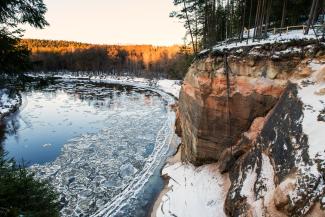
The sandstone layers exposed in river valleys and on steep seashores form expressive cliffs, which have become one of the most characteristic natural features of Vidzeme. Impressive natural views can be seen near Cēsis, where the Ērģeļu or Ērgļu cliffs rise on the banks of the Gauja. In the central section, one of the largest continuous sandstone walls in Latvia stretches 300 metres, the height of which reaches about 20 metres in some places. Niches and small caves are visible on the surface of the rock, while springs flow at its foot. From the upper edge, the wide landscape of the ancient Gauja valley opens up, and below, the river sweeps in a pronounced arc along the pale outcrop. Landslides are gradually transforming the relief of the cliff, so new forms have taken shape over time. The natural monument complex also includes the nearby Ramāti cliffs, which stand out on the banks of the old river with erosion-formed surfaces, niches and several small caves.
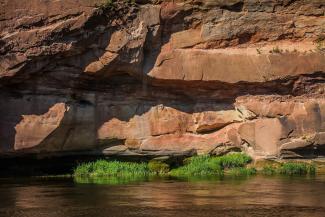
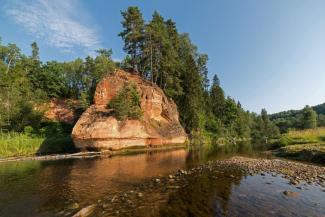
On the banks of the Amata River, surrounded by forests and meadows, rises Zvārte Rock – one of the most famous pink Devonian sandstone formations in Latvia. It has two distinct parts – an amphitheatre of collapsed cliff rising up to 44 metres, and a spur washed by the river, reaching 19 metres. The total length of the cliff is approximately 200 metres. The rock can be viewed from the shore and from the top, accessed via stairs, but further along the right bank of the Amata River, a section of the nature trail continues to Veclauči Bridge. Zvārte Rock has also been immortalised in Latvian cinema several times – scenes for the feature films “Frost in Spring”, “The Story of a Latvian Rifleman” and “Early Rust” were shot here.
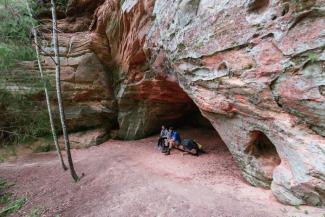
On the forested slopes of the left bank of the Gauja River, several hundred metres from the river, lies the more than kilometre-long Līči–Laņģi cliff complex. Its highest sections are 20–25 metres high, but they are not visible from the Gauja River. Around 20 springs flow at the foot, which have contributed to the creation of seven caves and several niches. The most notable of these is the Great Laņģi Cave with a system of passages more than 48 metres long. In the northern part, the collapse of the front part of an earlier cave has created a narrow gorge with walls approximately eight metres high. The area is covered by a nine-kilometre-long circular trail that begins at Lielā Ellīte and continues along the Lode quarry.
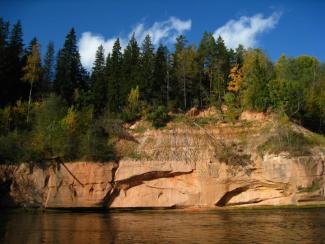
The Ķūķi cliffs are part of the protected Ķūķi, Edernieki and Leimaņi rock complex. The exposed strip of Ķūķi rock continues for approximately 570 metres; its visible wall is up to 15 metres high, while the entire cliff of the right bank of the Gauja River reaches 43 metres in places. In the lower part, the Ķūķi Great Cave and the Inaccessible Cave, up to 22 metres long, have been washed out, as well as separate hollows. Along the edge of the cliff, the river flows over a cluster of boulders, creating the Ķūķi rapids. The geological section also shows the clayey deposits of the Lode Suite.
Unusual rock formations and shapes created by water
Vidzeme offers incredibly beautiful natural formations that feature unusual compositions, colours, erosion forms, caves and different formation processes. On the right bank of the Gauja near Vaidava, you can see Sietiņiezis – a set of three white quartz sandstone outcrops, which reach a height of up to 15 metres over a length of approximately 400 metres, considered the largest outcrop of this colour in the Baltics. The rock is dotted with numerous small holes, thought to be the burrows of wild ground bees drawn to the sun-warmed sandstone, giving it the sieve-like look behind its name (from Latvian sietiņš, “little sieve”, and iezis, “cliff”). The circular trail takes you past caves and niches, cracks, and erosion gullies. In the southern section you’ll find Velnala, which is open at both ends, and Velna papēdis, a 15-metre-high sandstone pillar split by fissures and topped by a flat platform.
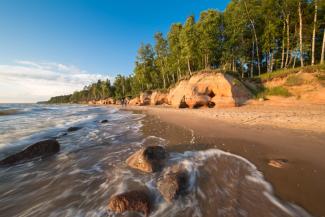
On the coast of Vidzeme are the Veczemju Cliffs, which form a 710-metre-long outcrop strip on the eastern steep shore of the Gulf of Riga. In the southern part, a continuous wall of 170 metres remains, while on the northern side, clay and siltstone layers are more common. Waves have eroded niches and shallow caves of various sizes, so the outline of the coast changes after storms. The combination of the sea, boulders and reddish rocks here creates an environment that is uncharacteristic among Latvian river valleys. Scenes for the multi-part film “The Long Journey in the Dunes” and the film “The Old Sailor’s Nest” were shot at the cliffs.
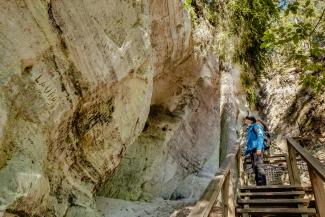
We will conclude the story of Vidzeme’s natural relics in the ancient Salaca Valley, following the Dauģēni Nature Trail. The ten-kilometre-long route leads along reddish rock outcrops, floodplain meadows and sections of river rapids. Its most striking landmark is the Dauģēni Cliffs with the two longest natural caves in Latvia – Dauģēni Lieli or Lielo X Cave and Dauģēni Mazo or Mazo X Cave. The total length of their branching passages is 346 and 159 metres, respectively. Springs flow from both caves, and the rocky strip can be easily viewed from a well-maintained platform.
If your Vidzeme adventure has inspired you to explore similar natural landscapes elsewhere in Latvia, create a trip that suits you using our portal’s route planner. Visit Latvia soon – there’s plenty here to discover.


